
Materials · August 5, 2026
HDF vs. MDF: what's actually behind a painted cabinet door
HDF vs. MDF: what's actually behind a painted cabinet door
Ask what a painted cabinet door is made of and most shops will say "MDF" without looking up. It's the trade default: medium-density fiberboard, stable, flat, cheap, and good enough for the day the kitchen is photographed. The question worth asking is what the door looks like at year five — at the edge profile, at the corner a dog ran into, at the spot under the sink where a drip sat overnight.
That question is why Belle Vie doors run on paint-grade HDF instead.
The difference is density, and density is everything
MDF and HDF are made the same way: wood fiber and resin pressed into a panel. The difference is how hard they're pressed. High-density fiberboard is a denser, harder-faced board than the MDF most shops accept, and every property a painted door lives or dies by follows from that one fact.
A harder face takes machining more cleanly. When a door profile is run — the bead on a New Castle, the integral molding on a Bernadette, the inside edge of a Shaker frame — the cutter leaves a crisper line in HDF because the fibers are packed too tightly to tear. Softer board fuzzes at the profile, and fuzz has to be sealed, sanded, and sealed again before paint will sit flat on it.
A denser core also moves less. Paint on a cabinet door is a thin, rigid film riding on the board underneath. The less the board swells and shrinks with a New England summer-to-winter swing, the longer that film stays a single unbroken surface.
Why sprayed finish is the real test
The reason we care isn't abstract materials science. It's the sprayed finish.
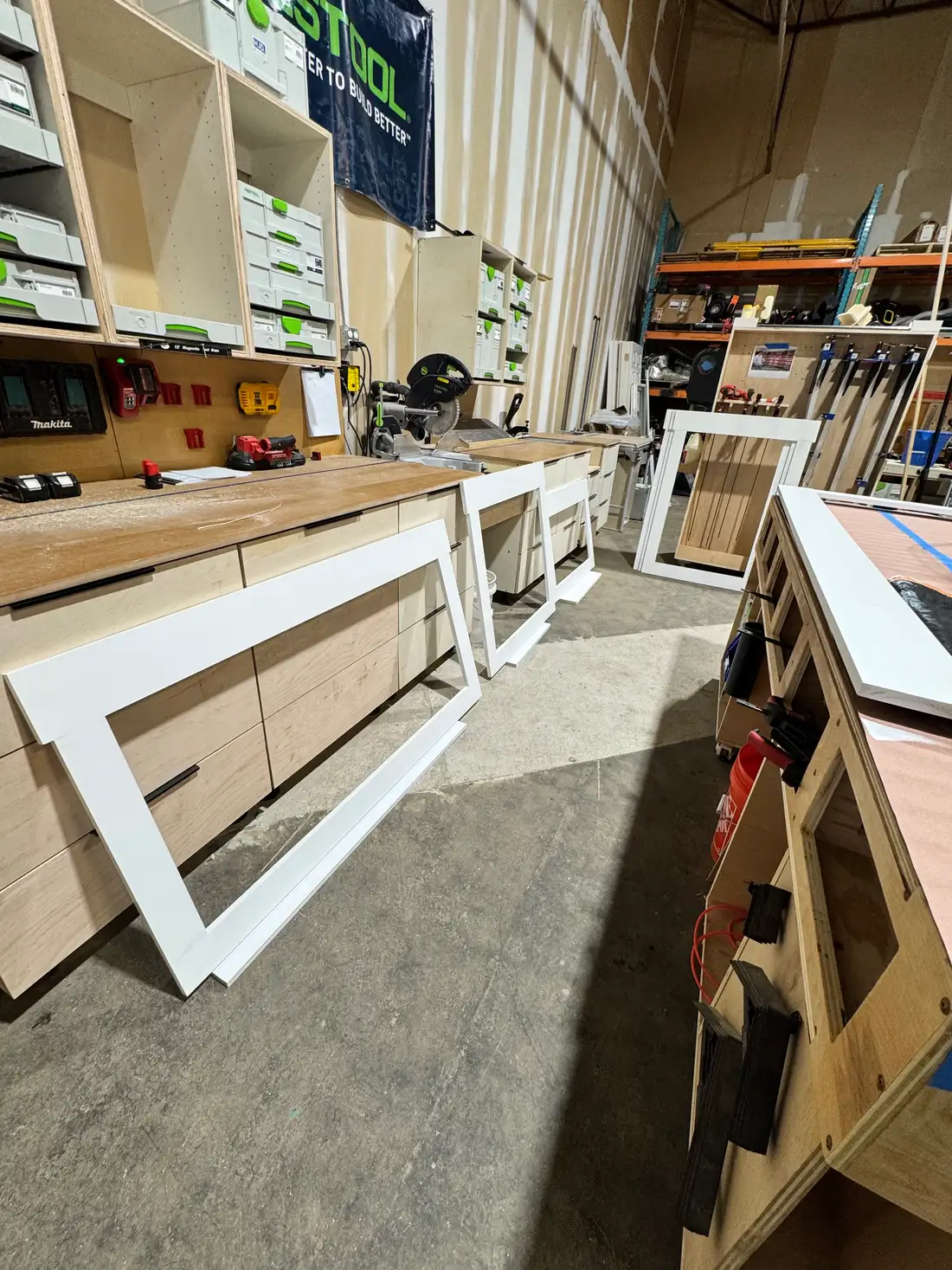
Every painted Belle Vie door is sprayed in a two-component conversion-varnish lacquer system — the door, the face frame, the end panels, all in the same lacquer, in the same pass, so the kitchen reads as one object instead of an assembly of parts finished in different places. A sprayed finish lays down glass-smooth on HDF and stays there. On a softer face, the first coat soaks in unevenly and the finish schedule turns into a fight: seal, sand, recoat, hope.
We publish three sheen levels — matte, satin, semi-gloss — and a sheen is only as honest as the surface under it. Semi-gloss in raking light shows every fiber that lifted under the primer. HDF is what lets us offer it without an asterisk.
What the rest of the cabinet is made of
The door is what you touch, but it's a quarter of the story. The cases — the boxes the doors hang on — are three-quarter-inch UV-finished maple hardwood plywood, cured under ultraviolet light at the mill. The inside of every cabinet arrives harder and cleaner than a shop-sprayed coat could make it, which is why a Belle Vie cabinet interior looks finished when you open it, not lined.
So the honest answer to "what's the cabinet made of" is two panels: UV-finished maple plywood where the cabinet does structural work, paint-grade HDF where a sprayed finish does the talking. Each panel is picked for what that part of the cabinet actually has to survive.
The panel we make ourselves
There's a third case, and it's the one we're proudest of. When a job calls for a wood species the sheet-goods catalog doesn't carry — or a veneer that needs to match a specific board — the panel comes off our own bench. A vacuum press in the Somersworth shop bonds sawn veneer to our own plywood cores, one panel at a time, balanced on both faces so the panel stays flat, and matched in sequence when a run of doors should read as one board.
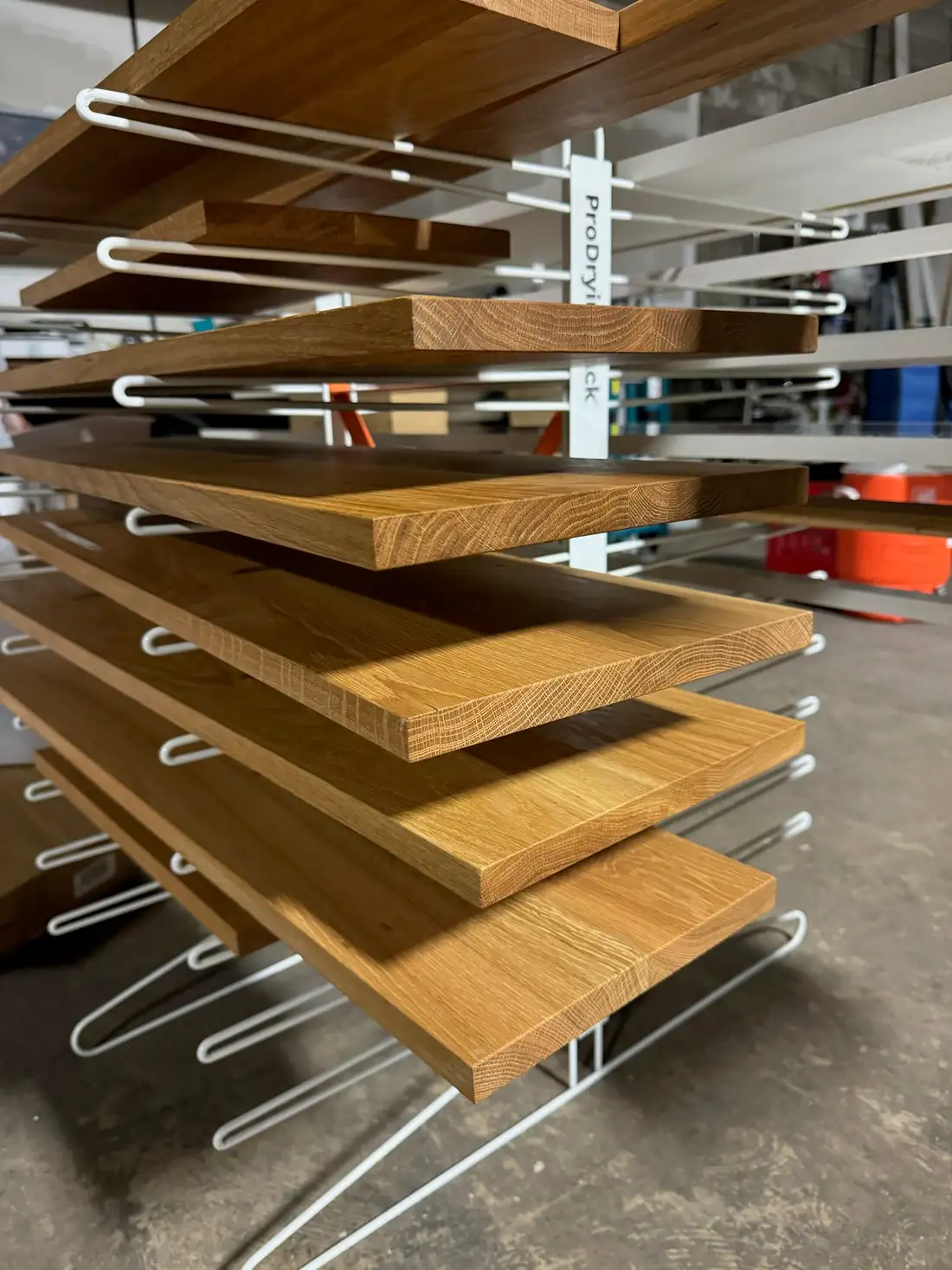
Most shops order veneered panels and take what arrives. Pressing in-house means the grain on door three continues from door two, because both faces came off the same flitch in order. It's the kind of detail nobody names on a walkthrough and everybody feels.
How to ask the question
If you're comparing cabinet quotes, you don't need to become a materials engineer. Three questions do the work:
- What board is under the paint? "MDF" is an answer. "Paint-grade HDF" is a better one.
- Who sprays the finish, and how? A factory-finished door next to a field-painted frame will always show the seam. One lacquer system, one pass, one standard is what to ask for.
- What are the cases made of? Particleboard, plywood, and UV-finished plywood are three different cabinets wearing the same doors.
The full method — case machining, doors, drawer boxes, joinery, finish, install, in the order the wood sees it — is on our construction page. The seven door profiles we build, and what each is made of, are on the cabinetry page.
And if you'd rather judge a finish with your hands than a spec sheet, that's what the sample box is for.
Reading about the process is one thing. Walking into it is better.
Start the intake